Module 05
California CCW Liability Laws Explained
Know the criminal and civil consequences of using a firearm before you carry in California.
Know the criminal and civil consequences of using a firearm before you carry in California.
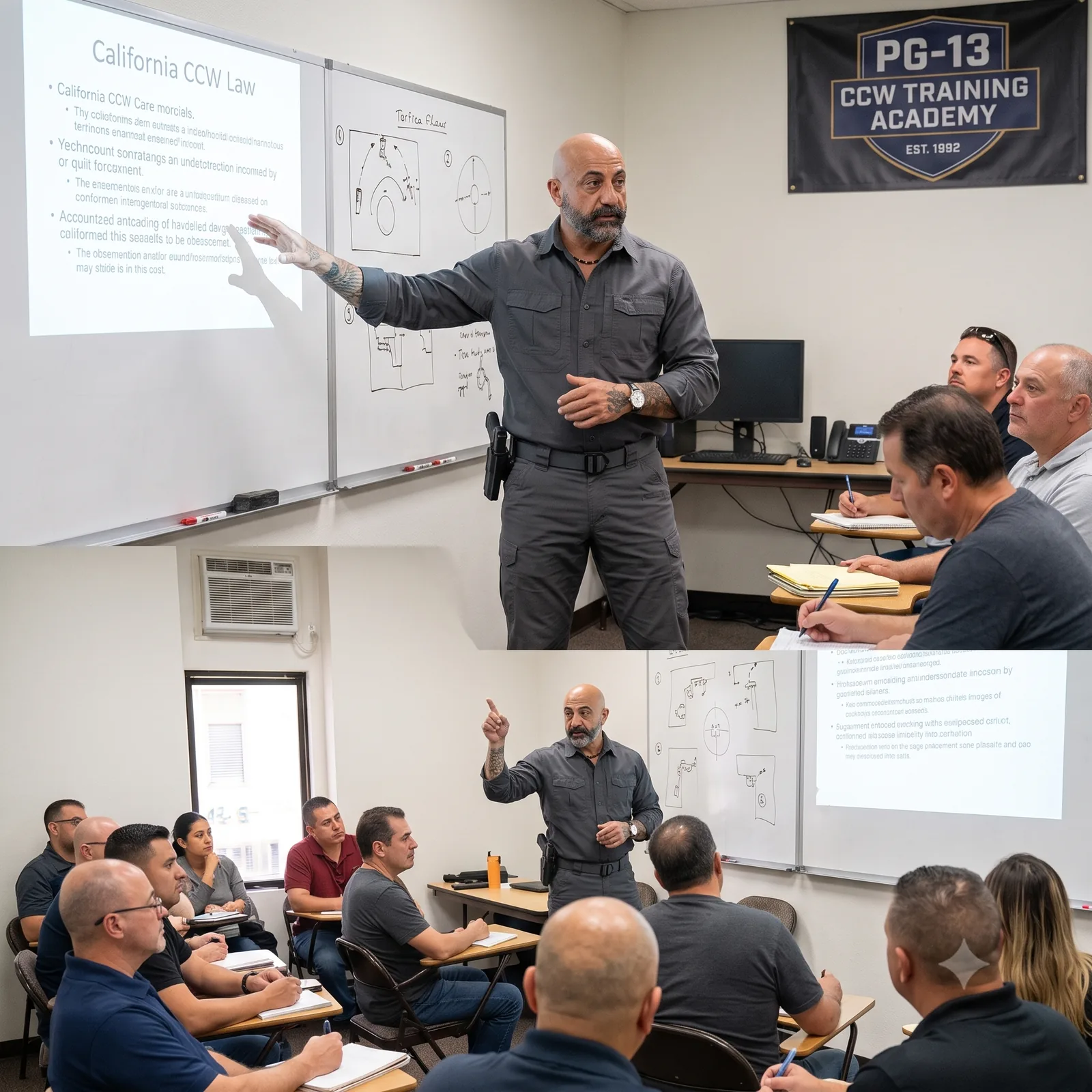
PG-13 CCW Training Academy's criminal and civil liability training in Van Nuys, CA covers what happens legally after a self-defense shooting, including how prosecutors evaluate your use of force, who can sue you in civil court, and how documented training strengthens your legal position in both arenas.
What Prosecutors Evaluate When Assessing a Use-of-Force Incident
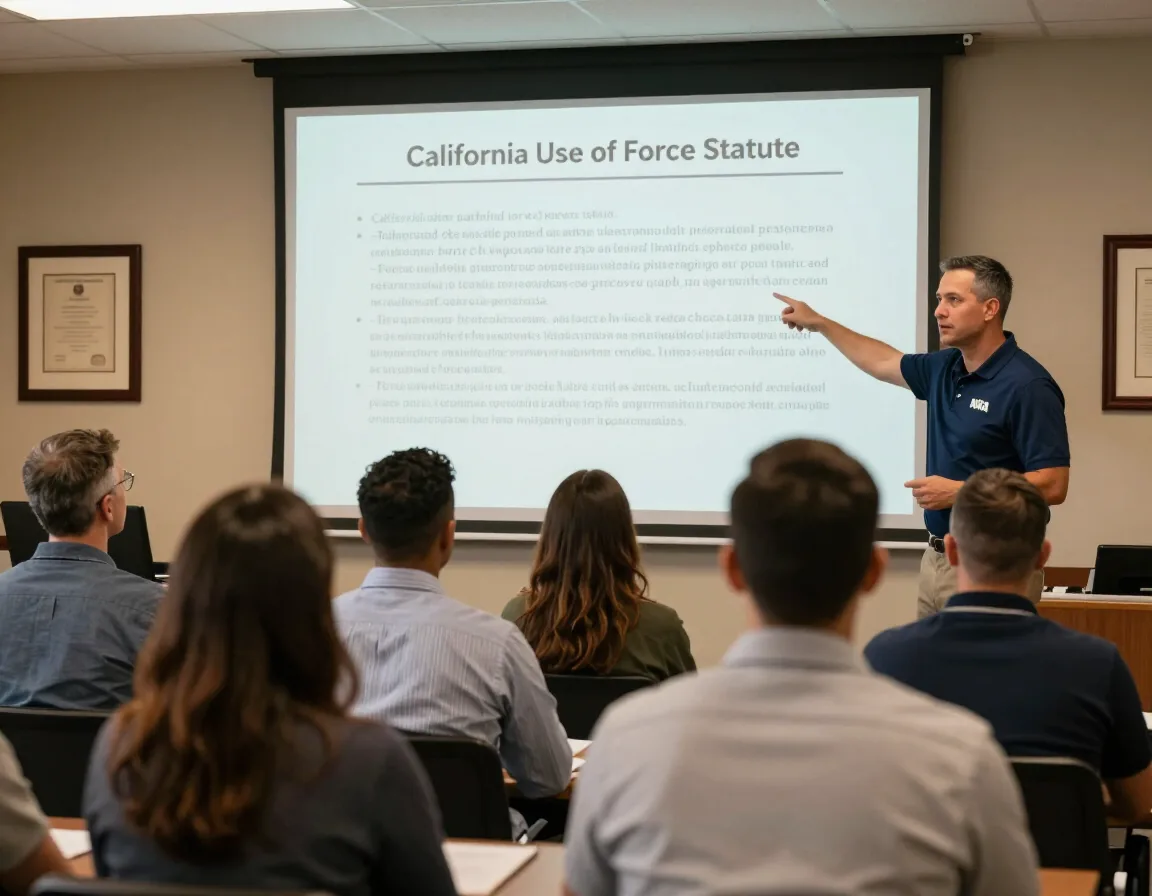
A self-defense incident may still be investigated by law enforcement and reviewed by prosecutors. Training helps students understand how factors such as perceived threat, reasonableness, proportionality, and post-incident actions can be examined during that process.
This module explains the legal considerations involved in use-of-force investigations and emphasizes the value of informed decision-making, sound judgment, and responsible conduct. Students gain a better understanding of the legal responsibilities that accompany concealed carry and self-defense situations.
Proper, documented training at a certified academy reduces your criminal exposure in a concrete way. When your decision-making under pressure reflects trained judgment, prosecutors take that into account. It does not guarantee any outcome, but it is evidence that you approached the situation with a legal framework in mind rather than reacting without basis.

Why a Criminal Acquittal Does Not End Your Legal Exposure
After a self-defense incident, the person you shot, their estate, or surviving family members can file a civil lawsuit against you regardless of what happens in criminal court. The civil standard of proof, preponderance of evidence, only requires showing it is more likely than not that you acted wrongfully. That is a much lower bar than "beyond a reasonable doubt," which means a civil loss is a realistic risk even after a criminal acquittal.
A plaintiff's attorney will argue negligence, recklessness, or inadequate training. They will ask whether you had formal instruction in the legal limits of force before you carried. Documented training from a certified academy is often cited by defense attorneys as evidence that you acted with reasonable care and understood the legal standards that applied to your situation.
Financial exposure in civil cases can include compensatory damages for medical costs, lost income, and pain and suffering, as well as punitive damages if the court finds your conduct was particularly reckless. The numbers can be substantial. This is not meant to alarm you, but the risk is real and worth understanding before you ever draw a firearm.

Trained Judgment Reduces Both Legal and Personal Risk in a Lethal Threat Scenario
The moment a CCW holder draws a firearm, the legal clock starts. Our criminal and civil liability module teaches students to run through a rapid mental checklist before acting: Is the threat real and immediate? Is your level of force proportionate? Have de-escalation options been exhausted? This is not abstract theory. It is grounded in California law and rehearsed until it becomes instinct.
This module connects directly to the curriculum on California use-of-force laws and the legal threshold for when lethal force is legally justified. Students who complete the full program graduate with a legally informed decision-making framework they can apply under real pressure, not a set of rules to recall from memory but a way of thinking that holds up when it counts.

Charges, sentencing enhancements, civil damages, and the license consequences that attach automatically under California law.
Misjudging a self-defense situation exposes you to serious felony charges. Which charge you face depends on your state of mind at the moment of the decision, and on whether a jury finds your fear was genuine, unreasonable, or fabricated entirely.
The trigger: deadly force used without an actual, honest belief in imminent danger, or force applied out of anger, retaliation, or mutual combat. The law calls this malice aforethought, either express (intent to kill) or implied (conscious disregard for human life).
The sentence: 15 years to life for second-degree murder. 25 years to life for first-degree.
The trigger: you held an actual, honest belief that you were in imminent danger, but a jury found that belief objectively unreasonable. This is imperfect self-defense under People v. Flannel (1979) 25 Cal.3d 668. Honest but unreasonable fear negates malice, which prevents a murder conviction. It does not excuse the killing.
The sentence: 3, 6, or 11 years in state prison.
The trigger: shots fired, the person survives, and the jury finds the force was legally unjustified.
The sentence: 5, 7, or 9 years for attempted voluntary manslaughter. Life with the possibility of parole for attempted murder.
The trigger: brandishing, pointing, or firing a weapon in a situation where lethal force was not legally justified, even when nobody is hit and nobody is injured.
The sentence: 2, 3, or 4 years in state prison under § 245(a)(2).
| Level of Misjudgment | Classification | Charge | Potential Sentence |
|---|---|---|---|
| No imminent danger, or acting from anger | Unlawful homicide | Murder (PC § 187) | 15 to 25 years to life, plus enhancements |
| Honest but unreasonable fear | Imperfect self-defense | Voluntary manslaughter (PC § 192) | 3, 6, or 11 years |
| Disproportionate force, non-lethal threat | Felony assault | Assault with a firearm (PC § 245) | 2, 3, or 4 years |
| Civil court determination | Tort / wrongful death | CCP § 377.60 | Financial judgment, asset seizure |
This is the part that surprises people. Under Penal Code § 12022.53, when a firearm is discharged during an offense where self-defense is rejected, mandatory state prison enhancements attach on top of the underlying sentence, consecutively.
An 11-year voluntary manslaughter term is not 11 years once an enhancement attaches. That arithmetic is the single strongest argument for taking the legal half of CCW training as seriously as the range half.
Even if a criminal jury acquits you, or prosecutors decline to file at all, a misjudged force decision carries heavy exposure in civil court. The two systems are separate proceedings with different rules, and winning one does not resolve the other.
| Criminal Court | Civil Court | |
|---|---|---|
| Standard of proof | Beyond a reasonable doubt | Preponderance of the evidence |
| Practical threshold | Near-certainty | More likely than not, roughly 51% |
| Jury agreement required | Unanimous, 12 of 12 | 9 of 12 |
| What is at stake | Prison, firearm rights, your record | Your income, savings, home, future earnings |
Under California Code of Civil Procedure § 377.60 (wrongful death) and Civil Code claims for battery, a plaintiff can pursue:
Plaintiff's counsel will build the case around whether you had formal instruction in the legal limits of force before you carried. Documented training from a certified academy is routinely cited by defense attorneys as evidence of reasonable care.
Several consequences attach automatically, without a separate hearing:
All of this sits downstream of one question a jury answers first: was the force justified in the first place? That analysis is covered in full in our guide to when deadly force is legally justified in California, and, if you intervened on someone else's behalf, in defending a third party under Penal Code 197.
This page is educational and is not legal advice. California law changes and applies to the specific facts of each situation. Consult a licensed attorney regarding your circumstances.