CCW Guides
Can You Legally Defend a Stranger in California?
The short answer is yes. Penal Code 197 covers "any other human being." The long answer is where carriers get into trouble.
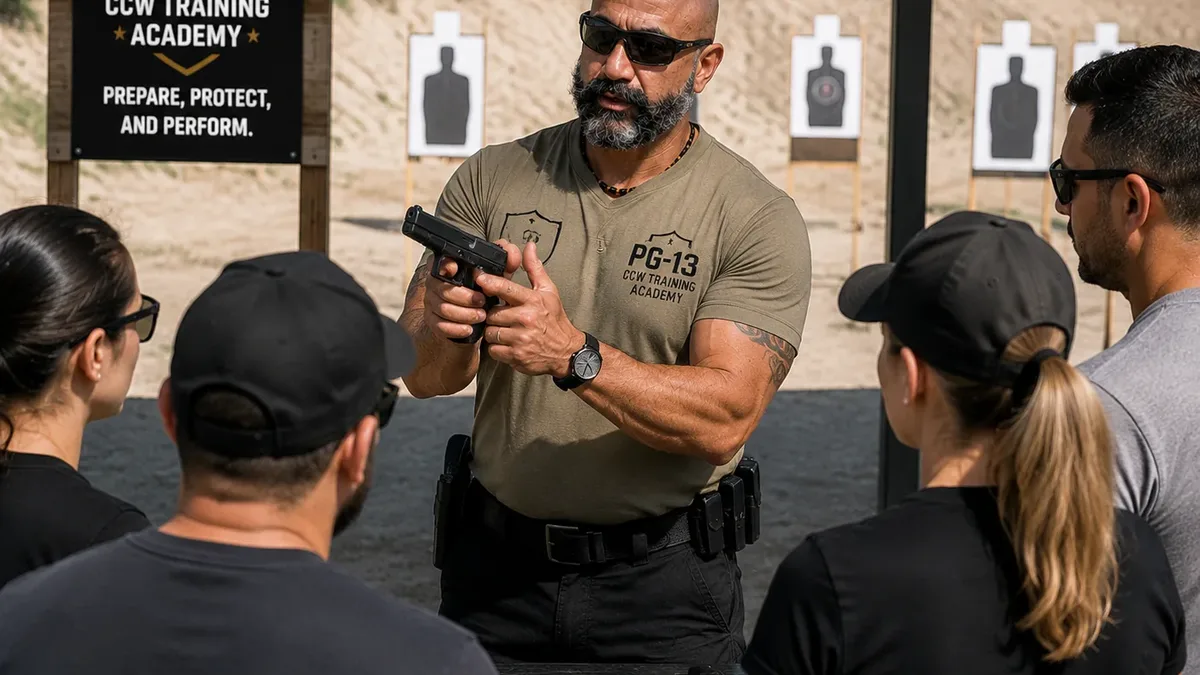
The short answer is yes. Penal Code 197 covers "any other human being." The long answer is where carriers get into trouble.
Every CCW class eventually hits the same question: if you walk into something ugly happening to somebody you have never met, are you allowed to intervene with a firearm? Under California law, you can legally defend anyone, including complete strangers. But intervening on behalf of a third party carries a specific set of legal risks that defending yourself does not.
Older common law sometimes limited third-party defense to family members or household dependents. Modern California law does not. Under Penal Code § 197(1), homicide is justifiable when committed:
The phrase "or any other human being" is what makes the statute universal. There is no familial, contractual, or domestic relationship requirement. The protection covers:
When you intervene, you inherit the victim's legal position. Your use of force is justified only if it would have been justified had they used it to defend themselves. You get no extra latitude for being the good samaritan, and no less either.
That framing matters, because it means the analysis runs through the same instruction, CALCRIM No. 505, that governs ordinary self-defense.
A jury must find that all three were satisfied at the moment force was deployed:
Like every California force analysis, this is a dual test.
Under CALCRIM No. 505, your belief can be legally reasonable even if it rested on appearances that turned out to be false. You are judged on what was apparent at the moment you acted, not on what an investigation later established.
The textbook example: you see an armed individual holding someone at gunpoint and reasonably believe a violent kidnapping or execution is in progress. If it later emerges that the armed individual was an undercover officer making a lawful arrest, your actions can still be legally justified, provided a reasonable person in your position, with the same visual and auditory cues, would have read the scene the same way.
Read that sentence carefully, because the protection is conditional. It shields reasonable misreadings. It does not shield careless ones.
California does not require a third-party defender to conduct an investigation or interview the participants before intervening when a threat appears imminent. Nobody expects you to run a fact-finding process while someone is being beaten.
What the law does do is place the risk squarely on you. If your read of who the primary aggressor was turns out to be objectively unreasonable, the justification fails. In a chaotic scene, the person who appears to be winning is not necessarily the person who started it, and a defender who guesses wrong is standing in the shoes of the aggressor rather than the victim.
In People v. Randle (2005) 35 Cal.4th 987, the California Supreme Court formally recognized the doctrine of imperfect defense of others, extending the Flannel rule to third-party cases.
This is a mitigation, not a defense. Voluntary manslaughter in California carries 3, 6, or 11 years in state prison, plus firearm enhancements, a lifetime firearm prohibition, and civil exposure that survives even a criminal acquittal. Our page on criminal and civil liability breaks down what that actually costs.
| Question | Answer |
|---|---|
| Who can you defend? | Anyone. Family, friends, or complete strangers. |
| What threat level is required? | Imminent death, Great Bodily Injury, or a forcible and atrocious felony. |
| Is a relationship required? | No. None of any kind. |
| Is there a duty to retreat? | No. California is stand-your-ground by jury instruction. |
| Who carries the burden of proof? | The prosecution, beyond a reasonable doubt. |
| Which instruction applies? | CALCRIM No. 505 for homicide, CALCRIM No. 3470 for non-homicide force. |
| Standard of proof | Identical to self-defense. |
The legal framework is permissive. The practical reality is that third-party intervention is the single highest-risk decision a concealed carrier can make, for reasons that have nothing to do with marksmanship.
None of this makes intervention unlawful. It makes it a decision that deserves to be rehearsed before it is required. Scenario work, verbal challenge, positioning, and knowing when the correct answer is to be an excellent witness with a phone rather than a participant with a firearm, that is the content of our self-defense module and use-of-force training.
This guide is general information for California CCW holders and applicants, not legal advice. Case law and jury instructions change. Confirm current standards with a California attorney before relying on any of it.