CCW Guides
How to Get a CCW in California
The complete step-by-step path from no permit to legally carrying concealed in California, updated for 2026.
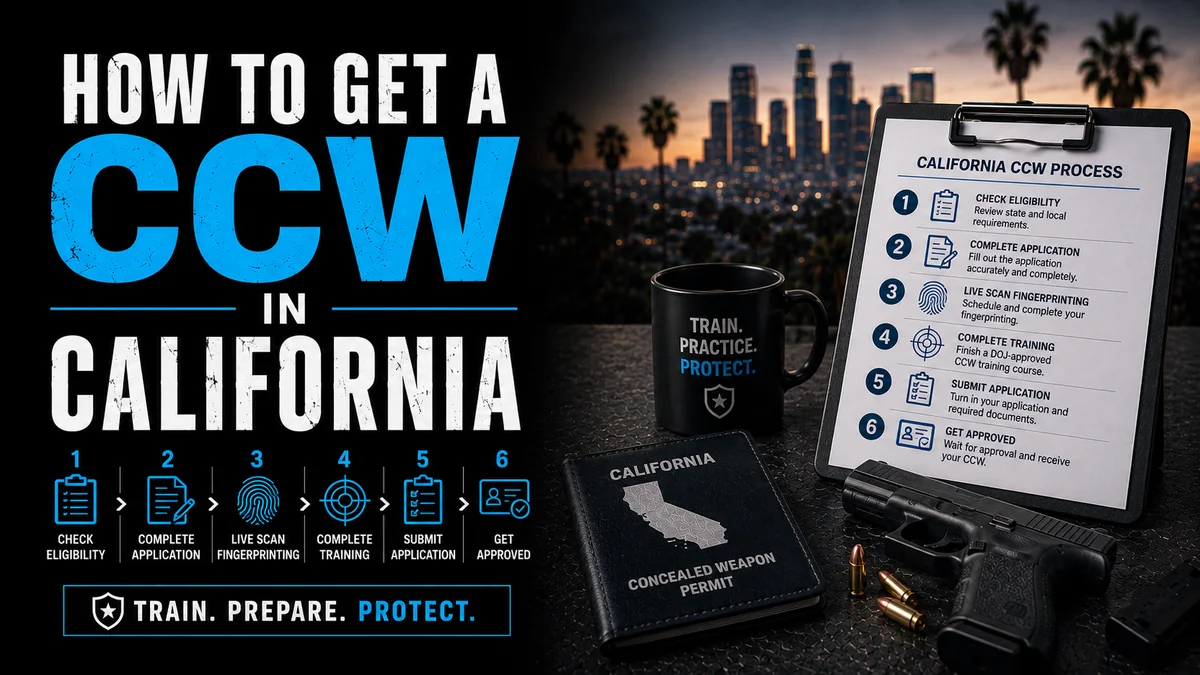
The complete step-by-step path from no permit to legally carrying concealed in California, updated for 2026.
Getting a California CCW (Carry Concealed Weapon) license is a defined legal process, not a lottery. Since the Bruen decision and California's SB 2, issuing authorities may no longer deny applicants for lacking "good cause" — if you meet the state's requirements and clear the screening, you can be licensed. Here is the full path, in order.
Before spending money on training or fees, check the basics. You must be at least 21, a resident of (or spend substantial time working in) the California county where you apply, not be prohibited from owning firearms under state or federal law, and not fall under SB 2's disqualifying criteria — things like recent violent misdemeanors, restraining orders, or DUI convictions within the past few years. Our California CCW requirements guide covers every criterion in detail.
California requires new applicants to complete a state-compliant 16-hour training course covering firearm safety, handling, mental health awareness, use-of-force law, and live-fire qualification with each handgun you intend to list on your permit. This is the one step entirely in your control — you can complete it before or during your application, and your certificate is the document every county asks for. See what the course covers in our initial vs renewal course breakdown, or view our classes.
CCW licenses are issued by your county sheriff (or, in some cities, the police chief). You'll complete the state's standard application, submit identification and residency documents, list the handguns you intend to carry, and pay initial fees. Every county runs its own portal and process — Los Angeles, Orange, San Bernardino, Riverside, Kern, and Ventura all differ in queue times and scheduling. Use our application checklist so nothing gets your file kicked back.
Expect an in-person interview with the issuing agency and a Live Scan fingerprint background check through the California DOJ. Counties may also require a psychological assessment (the fee is capped by state law). Answer honestly and completely — discrepancies between your application and interview are the most common avoidable problem.
After your background clears and training certificate is on file, the agency issues your license. Statute directs agencies to act within set timeframes, but real-world queues vary widely by county — see how long a CCW takes in California for realistic timelines. A standard California CCW is valid for two years.
Carrying legally is an ongoing responsibility: know where you can and can't carry under SB 2, keep your skills current, and calendar your renewal early — the renewal process requires an 8-hour course and is far easier if you start before expiration. Total out-of-pocket for the whole journey is covered in our cost breakdown.
This guide is general information for California CCW applicants, not legal advice. Laws and county procedures change — confirm current requirements with your issuing authority or an attorney.